
Key
Bacterial vaginosis (BV) and yeast infections are two common causes of vaginal discomfort. Both can cause itching, irritation, and unusual discharge, so it is easy to confuse them. However, they have different causes, symptoms, and treatments. Knowing the differences can help you understand what might be happening and when to seek medical care.
BV happens when the normal balance of bacteria in the vagina changes. A yeast infection occurs when a fungus called Candida grows too much. BV often causes thin discharge with a fishy smell, while a yeast infection more commonly causes thick, white discharge with intense itching. These symptoms can overlap, though, and some people have few or no symptoms. You cannot always tell which condition you have by looking at discharge or noticing an odor alone.
Understanding BV vs yeast infection can help you choose the right next step. Because the treatments are different, getting an accurate diagnosis is especially important if this is your first episode, symptoms keep returning, or you are unsure of the cause.
Quick Answer
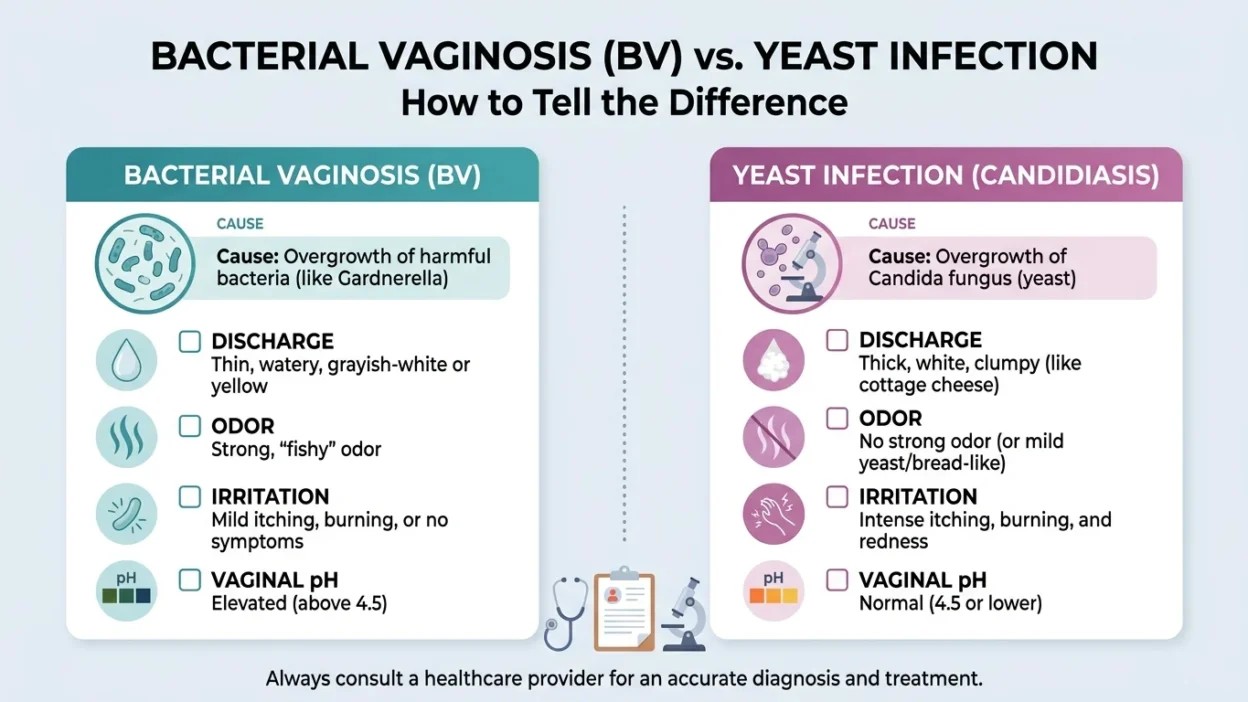
Bacterial vaginosis (BV) is caused by an imbalance of vaginal bacteria, while a yeast infection results from excess growth of Candida fungus. BV often causes thin, grayish-white discharge and a fishy odor. Yeast infections usually cause thick, white discharge, itching, and redness. A healthcare professional can help confirm the cause and recommend the correct treatment.
Why Do People Confuse BV and Yeast Infections?
People often confuse these conditions because both affect the vagina and can cause discomfort or changes in discharge.
The main reasons include:
- Similar symptoms: Both may cause irritation, unusual discharge, or discomfort.
- Overlapping signs: Not everyone experiences the typical symptoms.
- Different causes, similar location: BV involves bacteria, while yeast infections involve fungus.
- Incorrect self-diagnosis: Treating one condition as the other may delay effective treatment.
The most useful clues are the type of discharge, the presence of a strong odor, and how much itching or redness occurs. However, these clues cannot confirm a diagnosis on their own.
BV vs Yeast Infection: Main Differences
BV and yeast infections differ in their causes, common symptoms, and treatments. The following signs may help you understand the difference, but they are not enough to diagnose either condition.
CDC
+2
| Feature | Bacterial Vaginosis (BV) | Yeast Infection |
| Cause | Imbalance of vaginal bacteria | Overgrowth of Candida fungus |
| Discharge | Thin, white or gray | Often thick, white, and clumpy |
| Odor | Strong, fishy smell may occur | Usually little or no strong odor |
| Itching | May occur, but is not always present | Often a prominent symptom |
| Redness | Possible | Common, especially with irritation |
| Burning | May occur | May occur during urination |
| Vaginal pH | Often above 4.5 | Usually remains below 4.5 |
| Treatment | Antibiotics prescribed for BV | Antifungal medicine |
| Recurrence | Can return after treatment | Can return after treatment |
Sources: U.S. Centers for Disease Control and Prevention (CDC).
First Word: What Is BV?
BV stands for bacterial vaginosis. It is a common vaginal condition that develops when the usual balance of bacteria changes and certain bacteria become too abundant.
The vagina normally contains a mix of microorganisms. When this balance changes, BV may develop.
Common Symptoms of BV
Some people have no symptoms. Others may notice:
- Thin, grayish-white vaginal discharge.
- A fishy vaginal odor, sometimes stronger after sex.
- Mild vaginal itching or irritation.
- Burning during urination.
- Discomfort around the vagina.
BV is not classified as a sexually transmitted infection (STI), but sexual activity can influence the risk. It can also occur in people who have not had sex.
How Is BV Treated?
Healthcare professionals commonly treat symptomatic BV with antibiotics such as metronidazole or clindamycin. The appropriate medicine depends on the person’s situation.
Avoid vaginal douching because it can disturb the natural bacterial balance and may increase the risk of recurrence. BV can return even after successful treatment.
Second Word: What Is a Yeast Infection?
A vaginal yeast infection, also called vaginal candidiasis, occurs when Candida fungus grows excessively.
Candida can live naturally in the body without causing problems. However, changes in the body’s environment can allow it to grow too much and cause symptoms.
Common Symptoms of a Yeast Infection
Typical symptoms include:
- Strong vaginal or vulvar itching.
- Thick, white discharge that may look like cottage cheese.
- Redness or swelling around the vaginal opening.
- Soreness and irritation.
- Burning during urination.
- Pain during sexual intercourse.
The discharge often has little or no strong odor. However, symptoms can vary, and not every yeast infection produces thick discharge.
How Is a Yeast Infection Treated?
Yeast infections are treated with antifungal medicines. Depending on the circumstances, these may include vaginal creams, suppositories, or oral medication.
Antibiotics used to treat BV do not treat a yeast infection. In fact, antibiotic use can sometimes increase the risk of developing one.
If you are pregnant, consult a healthcare professional before choosing treatment. During pregnancy, recommended treatment for vaginal yeast infections generally involves a seven-day course of topical azole medication rather than oral fluconazole.
When Should You Use Each Term?
BV and yeast infection are medical conditions, so the terms should be used according to the actual diagnosis or the condition being discussed.
Use bacterial vaginosis (BV) when talking about a bacterial imbalance in the vagina.
Use yeast infection when talking about an infection caused by excessive growth of Candida fungus.
For example, if a healthcare professional confirms BV, calling it a yeast infection is incorrect because the causes and treatments differ.
If you are describing symptoms before receiving a diagnosis, use neutral language such as “vaginal itching,” “unusual discharge,” or “vaginal odor.” This avoids assuming the cause before it is known.
12 Examples of BV vs Yeast Infection Symptoms
These examples show how the terms can be used in everyday language. The symptoms described are possible clues, not proof of a diagnosis.
- BV: She noticed thin, grayish-white discharge with a fishy odor.
- Yeast infection: She experienced intense itching and thick, white discharge.
- BV: Her healthcare provider diagnosed bacterial vaginosis after testing.
- Yeast infection: The examination suggested a fungal infection.
- BV: She received antibiotics prescribed for bacterial vaginosis.
- Yeast infection: She used an antifungal medicine as directed.
- BV: Her symptoms returned a few weeks after treatment.
- Yeast infection: Redness and swelling developed around the vaginal opening.
- BV: She had an unusual odor but very little itching.
- Yeast infection: Urination caused burning because the surrounding tissue was irritated.
- BV: Her vaginal fluid test showed signs of a bacterial imbalance.
- Yeast infection: A vaginal sample helped confirm Candida overgrowth.
Remember that BV and yeast infections can produce overlapping symptoms. Some people may also have another condition, such as trichomoniasis, which can cause discharge and irritation. Testing can help identify the correct cause.
Common Mistakes to Avoid
Several misunderstandings can make it harder to recognize and treat vaginal symptoms.
- Mistake 1: Assuming all unusual discharge means a yeast infection. BV and other conditions can also cause discharge changes.
- Mistake 2: Assuming a fishy odor always confirms BV. Odor is a clue, not a definite diagnosis.
- Mistake 3: Using antifungal medicine for BV. Antifungal medicines target fungi, not the bacterial imbalance that causes BV.
- Mistake 4: Taking antibiotics for a suspected yeast infection. Antibiotics do not treat Candida overgrowth and may contribute to yeast infections.
- Mistake 5: Treating recurring symptoms without medical advice. Repeated symptoms may have a different cause or need a different treatment.
- Mistake 6: Using scented products or vaginal douches to remove odor. These products may irritate sensitive tissue or disturb the vaginal environment.
If symptoms are new, persistent, severe, or keep returning, arrange a medical evaluation instead of repeatedly trying different treatments.
Memory Trick: How to Remember the Difference
Use this simple memory aid:
- BV = Bacteria and bad odor. A fishy smell and thin discharge are common clues.
- Yeast = Itching and irritation. Thick, white discharge and significant itching are common clues.
This trick can help you remember the usual patterns, but it cannot confirm which condition you have. Some people have unusual symptoms or no noticeable symptoms at all.
American vs British English
The terms bacterial vaginosis (BV) and yeast infection are widely understood in American English.
In British English, people may use the term thrush for a vaginal yeast infection. The medical term vaginal candidiasis is also used in both varieties of English.
| American English | British English | Meaning |
| Yeast infection | Vaginal thrush | Fungal infection caused by Candida |
| Bacterial vaginosis | Bacterial vaginosis | Imbalance of vaginal bacteria |
| Vaginal discharge | Vaginal discharge | Fluid released from the vagina |
| Healthcare provider | Healthcare professional | Person who provides medical care |
The medical differences between BV and yeast infections do not change between American and British English.
Similar Words and Related Conditions
A few related medical terms are worth understanding because they can be confused with BV or yeast infections.
- Vaginitis: A general term for inflammation of the vagina. It can have several causes.
- Vaginal candidiasis: The medical name for a vaginal yeast infection.
- Trichomoniasis: An STI caused by a parasite that can cause discharge, odor, and irritation.
- Urinary tract infection (UTI): An infection affecting the urinary system that can cause painful or frequent urination.
- Vaginal pH: A measurement of how acidic the vaginal environment is. It can help a healthcare professional assess certain vaginal conditions.
- Mixed infection: A situation in which more than one condition is present at the same time.
These conditions can share symptoms, which is why a professional assessment may be necessary.
Final Verdict: BV vs Yeast Infection
The biggest difference between BV and a yeast infection is their cause. BV results from an imbalance of vaginal bacteria, while a yeast infection occurs when Candida fungus grows excessively.
BV more often causes thin discharge and a fishy odor. A yeast infection more often causes intense itching, redness, and thick, white discharge.
Neither pattern is universal. If you are unsure which condition you have, a healthcare professional can examine your symptoms and perform appropriate tests to determine the cause.
Frequently Asked Questions
1. How can I tell if I have BV or a yeast infection?
A fishy odor and thin, grayish-white discharge are more typical of BV. Intense itching, redness, and thick, white discharge are more typical of a yeast infection. However, symptoms overlap, so testing may be needed for an accurate diagnosis.
2. Which is worse, BV or a yeast infection?
Neither is always worse. Both are common and treatable, but their effects differ. Yeast infections often cause more itching and irritation, while BV may cause odor and discharge changes. BV is associated with certain STI risks and pregnancy complications, making appropriate evaluation important.
3. Can you have BV and a yeast infection at the same time?
Yes. Both conditions can occur together. If symptoms do not match a typical pattern, or treatment for one condition does not help, a healthcare professional may test for both.
4. Can a yeast infection turn into BV?
No. A yeast infection does not directly turn into BV because they have different causes. However, a person can develop either condition at different times or experience both together.
5. Can BV go away without treatment?
BV sometimes resolves on its own, but symptomatic BV should be assessed by a healthcare professional. Treatment can relieve symptoms and help address potential risks. Seek medical advice if symptoms persist or return.
6. Can a yeast infection go away without medicine?
Some mild symptoms may improve, but symptoms alone cannot confirm a yeast infection. Because other conditions can look similar, it is best to obtain an accurate diagnosis when you are unsure, especially if symptoms are new, severe, or recurring.
7. Do BV and yeast infections require different medicines?
Yes. BV is treated with antibiotics, while yeast infections are treated with antifungal medicines. Using the wrong medicine may not help and can delay proper treatment.
8. When should I see a healthcare professional?
Seek medical advice if this is your first episode, symptoms persist or return, or you have severe pain, fever, unusual bleeding, or pelvic pain. If you are pregnant and notice unusual discharge or irritation, contact your healthcare professional promptly.
Remember This
- BV: Bacterial imbalance, often thin discharge and a fishy odor.
- Yeast infection: Candida overgrowth, often itching and thick, white discharge.
- Treatment: Antibiotics for BV; antifungal medicines for yeast infections.
- Diagnosis: Symptoms can offer clues, but testing may be needed.
Do not assume that odor, itching, or discharge alone identifies the cause. The right diagnosis helps you receive the right treatment.
Conclusion
Understanding BV vs yeast infection can help you recognize common symptoms and make informed decisions about vaginal health. BV involves a change in the balance of vaginal bacteria, while a yeast infection occurs when Candida fungus grows excessively. Their symptoms can overlap, but their usual discharge patterns, odors, and levels of itching may differ.
If you notice unusual discharge, persistent itching, a strong odor, or recurring discomfort, speak with a healthcare professional. Avoid guessing the cause or using the same medicine for every vaginal problem. An accurate diagnosis and appropriate treatment can help relieve symptoms and protect your health.

Alexander Cody is a Bible researcher and Christian writer at BiblePeak, dedicated to exploring biblical codes, Scripture insights, and faith-based studies. He creates clear, engaging, and well-researched content that helps readers better understand the Bible and its timeless messages.