
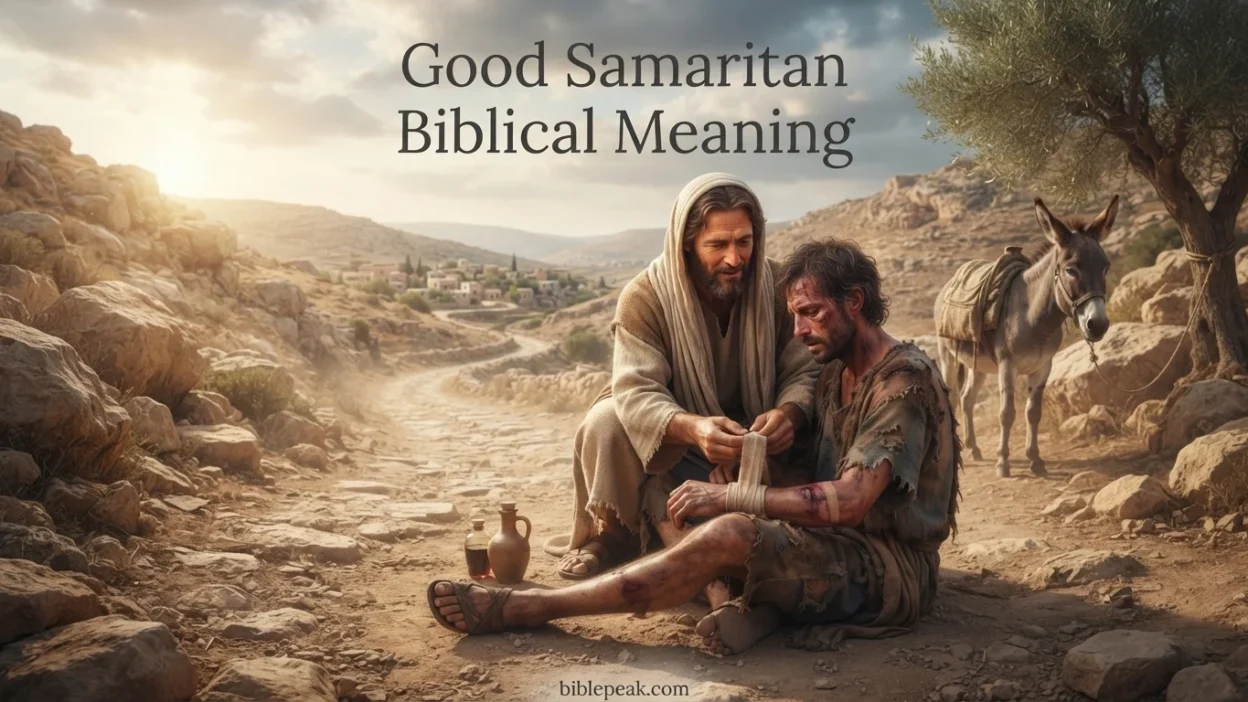
Imagine walking down a lonely road and seeing someone hurt and helpless. Many people pass by. Some look away. But one person stops, kneels down, and helps.
This is the powerful picture Jesus gives us in the Parable of the Good Samaritan.
The story is found in Luke 10:25–37. A man is attacked by robbers and left on the road. A priest sees him but walks away. A Levite also sees him but does not help. Then a Samaritan comes near. He feels compassion, cares for the wounded man, and pays for his care.
But what does the Good Samaritan biblical meaning teach us today?
The story is more than a lesson about being kind. It reveals the heart of God. It teaches us to show mercy, love, compassion, and kindness even when helping someone is difficult or inconvenient.
Jesus told this story after a man asked, “Who is my neighbor?” Instead of giving a simple list of people to love, Jesus showed what real love looks like.
The Good Samaritan reminds us that Christian love is not only something we feel. It is something we do.
When we see someone hurting, God calls us to respond with a loving heart. This simple story can change how we treat family, friends, strangers, and even people who are different from us.
Let us look deeper at what this story means in the Bible and what spiritual message it may have for our lives.
Biblical Meaning of the Good Samaritan
The main Good Samaritan biblical meaning is mercy expressed through action. Jesus teaches that true love does not stop at words. It reaches out to people in need.
1. The Good Samaritan Represents Compassion
The Samaritan saw a wounded man and did not ignore him.
Luke 10:33 says that when he saw the man, he had compassion on him.
This is important because compassion begins with seeing another person’s pain. The Samaritan did not simply feel sorry for the wounded man. He moved toward him and helped him.
As Christians, we may see people who are lonely, broken, afraid, or struggling. The Bible encourages us to care.
1 John 3:18 teaches that we should love not only with words but also through our actions.
The spiritual message is simple: Love becomes powerful when we act on it.
2. The Good Samaritan Shows What Loving Your Neighbor Means
The question that led to the story was, “Who is my neighbor?”
Jesus changed the focus.
Instead of asking, “Who deserves my love?” we should ask, “How can I show love?”
The Samaritan helped someone who was a stranger. He did not wait to learn the man’s background. He did not ask whether the man could repay him.
He simply saw a need and responded.
This connects with Leviticus 19:18, which teaches God’s people to love their neighbor as themselves.
Jesus shows that our neighbor is not only the person who lives beside us. A neighbor can be anyone God places in our path who needs mercy.
3. The Samaritan Teaches Us to Love Beyond Differences
The story becomes even more powerful because Samaritans and Jews had deep social and religious tension.
Yet the Samaritan helped the injured Jewish man.
This teaches a strong lesson about Christian love. God’s love is bigger than human divisions.
We may have differences in culture, background, wealth, opinions, or life experience. But every person has value.
Galatians 6:2 encourages believers to carry one another’s burdens.
The Good Samaritan shows us that faith should lead us to build bridges, not walls.
4. Mercy Can Require Sacrifice
The Samaritan did more than offer a quick word of comfort.
He went to the wounded man, treated his wounds, placed him on his animal, took him to an inn, and paid for his care.
His kindness cost him time, effort, comfort, and money.
This gives the story a deeper biblical meaning.
Real compassion can require sacrifice.
Sometimes helping someone means giving up our plans. Sometimes it means listening when we are tired. Sometimes it means giving financial help, offering practical support, or simply staying with someone who feels alone.
Philippians 2:4 teaches believers to look not only to their own interests but also to the interests of others.
5. The Story Points Us Toward God’s Mercy
The Good Samaritan can also remind Christians of God’s great mercy.
Human beings can become spiritually broken through sin, fear, pain, and wrong choices. Yet God does not turn away from us.
The Bible says in Ephesians 2:4–5 that God is rich in mercy and gives life through Christ.
The Samaritan’s care gives us a beautiful picture of mercy moving toward someone in need.
This does not mean the Samaritan is a direct symbol of Jesus in every detail. Rather, the story helps us understand a central truth of the gospel: God calls His people to receive mercy and then show mercy to others.
6. There Is Also a Warning in the Story
The priest and Levite saw the wounded man, but they passed by.
This gives us a gentle warning.
It is possible to know about faith while failing to show love.
We may be busy with work, family, church, or personal problems. We may notice someone’s pain but think, “Someone else will help.”
The story asks us to look at our own hearts.
Do we notice people who need help, or do we walk past them?
Jesus ends the lesson with a clear command: “Go and do likewise” (Luke 10:37).
Spiritual Significance and Symbolism
The spiritual symbolism of the Good Samaritan centers on mercy, compassion, love, and action.
The wounded man can remind us of people who are hurting around us. The Samaritan reminds us of the kind of heart God wants His followers to have.
Mercy That Moves
The Samaritan did not keep his compassion inside.
He moved.
This is a powerful lesson for our spiritual journey. Prayer is important. Bible study is important. Worship is important. But our faith should also affect how we treat people.
A simple act of kindness can become a spiritual message to someone who feels forgotten.
A meal for a hungry person, a kind word to someone who is sad, or help for someone facing a hard season can show God’s love in practical ways.
Seeing People Through God’s Eyes
The story also teaches us to slow down and notice people.
Someone may smile while carrying deep pain. A coworker may need encouragement. A neighbor may feel alone. A family member may need someone to listen.
The Good Samaritan teaches us to become people who see, care, and respond.
Faith That Produces Transformation
Christian growth is not only about learning more facts. It is about becoming more like Christ.
As we grow in faith, God can soften our hearts and help us become more patient, generous, forgiving, and compassionate.
This is part of spiritual transformation.
The Good Samaritan invites us to ask during prayer:
“Lord, help me notice the people You want me to help.”
That simple prayer can change the way we see everyday life.
Biblical Interpretations in Dreams or Real Life
If the Good Samaritan appears in a dream, vision, conversation, or meaningful life situation, it may remind you of themes such as mercy, service, compassion, or helping others.
However, the Bible does not teach that every dream has a special divine meaning. Christian dream interpretation should always be tested against Scripture and prayer.
For example, dreaming about helping an injured person may encourage reflection on whether someone in your life needs support. Seeing yourself as the wounded person may remind you that it is okay to receive help when you are struggling.
If the dream feels peaceful, it may lead you toward thoughts of kindness and service. If it feels fearful or troubling, bring it to God in prayer rather than assuming it is a warning from Him.
The safest foundation is always Scripture.
James 1:5 reminds believers to ask God for wisdom. When you are unsure what something means, pray for wisdom and seek God’s guidance.
Practical Lessons & Faith Insights
The Good Samaritan teaches us to see, care, and act.
Look for simple ways to show mercy today. Listen to someone who needs support. Help when you can. Give without seeking praise. Pray for people who are hurting.
Most of all, remember that Christian faith is shown through love in action.
Conclusion
The Good Samaritan biblical meaning is a beautiful call to mercy, compassion, and active love. Jesus teaches us that our neighbor may be anyone who needs our care, even someone very different from us.
God invites us to notice hurting people and respond with kindness. As you walk through life, ask Him to give you eyes to see, a heart to care, and courage to help.
When love leads the way, even a small act of mercy can reflect the heart of God.

Claire Ella is the Administrator of BiblePeak, overseeing content quality, website operations, and community engagement. She is dedicated to presenting coded Bible insights with accuracy, clarity, and integrity, ensuring every visitor enjoys a trustworthy, meaningful, and enriching experience.