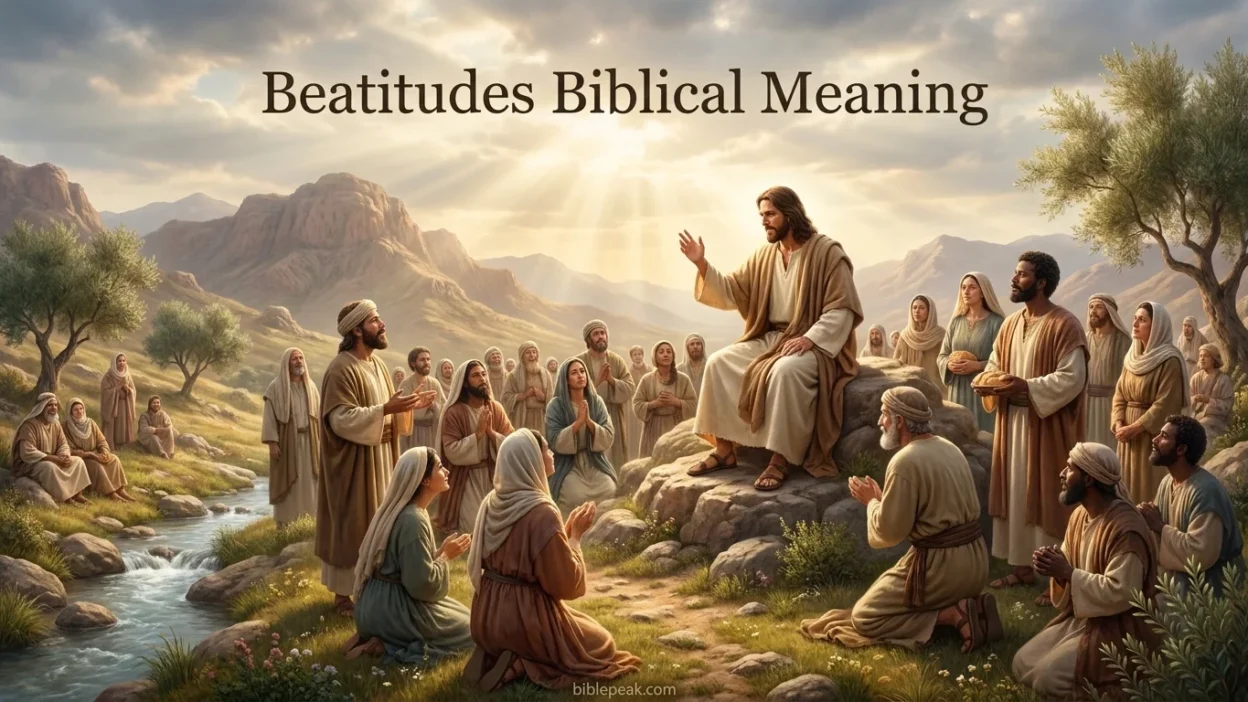
Imagine sitting quietly on a hillside, listening to Jesus speak about a new way to live. His words are simple, yet they reach deep into the heart. He speaks about the below in spirit, those who mourn, the meek, the merciful, and those who hunger for righteousness.
These teachings are known as the Beatitudes.
But what is the Beatitudes biblical meaning? Why did Jesus call people blessed when they were hurting, humble, hungry for righteousness, or facing persecution?
The Beatitudes can seem surprising at first. The world often calls the rich, powerful, successful, and strong blessed. Jesus gives a different picture. He shows that true blessing is not always found in comfort or earthly success. It is found in a heart that seeks God.
The Beatitudes teach us about faith, humility, mercy, peace, righteousness, and hope. They show the kind of heart God values and the blessings that come from living close to Him.
For Christians, these teachings are more than ancient words. They can guide our daily lives, prayers, choices, and relationships. They remind us that God sees the heart, comforts those who hurt, and promises His presence to those who follow Him.
To understand their deeper message, we need to look at what Jesus actually taught in the Bible.
Biblical Meaning of the Beatitudes
The Beatitudes are found mainly in Matthew 5:3–12, at the beginning of Jesus’ Sermon on the Mount. The word “beatitude” means a state of blessing or deep spiritual happiness.
Jesus begins many statements with the words “Blessed are…” He then describes different people and gives a promise connected to each one.
Blessed Are the below in Spirit
Jesus says, “Blessed are the below in spirit, for theirs is the kingdom of heaven” (Matthew 5:3).
Being below in spirit does not mean having no value. It means knowing that we need God. It describes a heart that is humble and does not depend only on its own strength.
This teaches us that spiritual growth begins with humility. When we admit that we need God, we become open to His grace and guidance.
Blessed Are Those Who Mourn
Matthew 5:4 says, “Blessed are those who mourn, for they shall be comforted.”
Mourning can come from loss, pain, sin, disappointment, or deep sorrow. Jesus does not ignore human suffering. He promises comfort.
This is a beautiful message of hope. When your heart is broken, God has not forgotten you. His comfort may come through prayer, Scripture, other believers, or His quiet presence.
Blessed Are the Meek
Jesus says, “Blessed are the meek, for they shall inherit the earth” (Matthew 5:5).
Meekness is not weakness. It means having strength under control. A meek person does not need to prove himself through anger, pride, or revenge.
The biblical meaning of meekness points toward gentleness, patience, humility, and trust in God.
Instead of fighting for control, believers can place their lives in God’s hands.
Blessed Are Those Who Hunger and Thirst for Righteousness
Matthew 5:6 says that those who hunger and thirst for righteousness will be filled.
Jesus uses the picture of strong hunger and thirst. It shows a deep desire to live in a way that pleases God.
This Beatitude teaches that righteousness should not be something we only talk about. It should become something we truly desire.
A Christian may pray, “Lord, help me become more like You.” That simple prayer reflects the hunger for righteousness Jesus describes.
Blessed Are the Merciful
Jesus says, “Blessed are the merciful, for they shall obtain mercy” (Matthew 5:7).
Mercy means showing compassion instead of responding with harsh judgment. It can mean forgiving someone, helping someone who is struggling, or choosing kindness when anger would be easier.
The Christian meaning of mercy is closely connected to the mercy God has shown us.
When we understand God’s grace, we become more willing to extend grace to others.
Blessed Are the Pure in Heart
Matthew 5:8 says, “Blessed are the pure in heart, for they shall see God.”
Purity of heart is about inner character. It means seeking God sincerely instead of living with a divided heart.
This does not mean that Christians never make mistakes. Rather, it points to a heart that honestly wants God and desires to walk in His ways.
A pure heart seeks truth, rejects hidden evil, and keeps turning back toward God through repentance and prayer.
Blessed Are the Peacemakers
Jesus says, “Blessed are the peacemakers, for they shall be called sons of God” (Matthew 5:9).
A peacemaker does more than avoid arguments. A peacemaker actively seeks reconciliation, forgiveness, understanding, and love.
This can happen in a family, friendship, marriage, church, or workplace.
Sometimes making peace takes courage. It may require saying sorry, forgiving someone, or choosing calm words instead of angry ones.
Blessed Are Those Who Are Persecuted for Righteousness
Matthew 5:10–12 teaches that those who suffer because of righteousness are blessed.
This is one of the most challenging Beatitudes. Jesus does not promise that following Him will always be easy.
Some believers may experience rejection, criticism, or hardship because of their faith. Yet Jesus reminds them that their reward in heaven is great.
The message is clear: faithfulness to God is valuable even when others do not understand it.
The Beatitudes therefore carry both comfort and challenge. They comfort hurting people, but they also challenge believers to live with humility, mercy, purity, peace, and righteousness.
Spiritual Significance and Symbolism of the Beatitudes
The spiritual symbolism of the Beatitudes points to a transformed heart.
Jesus is not simply giving a list of rules. He is showing what life looks like when a person learns to depend on God.
The Beatitudes turn normal human thinking upside down. The humble are blessed. The mourners receive comfort. The meek receive an inheritance. The merciful receive mercy.
This teaches an important spiritual truth: God sees value where the world may not see it.
The Beatitudes Teach Humility
The first Beatitude reminds us that we need God. Spiritual growth begins when pride becomes surrender.
Instead of saying, “I can handle everything myself,” faith says, “God, I need You.”
They Teach Compassion
The Beatitudes also create a heart that notices the pain of others.
Someone who has experienced sorrow may understand another person’s tears. Someone who has received mercy may become more willing to show mercy.
They Teach Inner Transformation
The Beatitudes focus strongly on the heart.
They encourage believers to become people who are:
- Humble instead of proud
- Merciful instead of harsh
- Pure instead of divided
- Peaceful instead of angry
- Righteous instead of careless
- Faithful instead of fearful
This is why the Beatitudes are important for Christian growth. They show that following Jesus is not only about what we say. It is also about who we are becoming.
Biblical Interpretations of the Beatitudes in Dreams or Real Life
People may encounter the Beatitudes through Bible reading, prayer, sermons, dreams, or personal experiences.
If the Beatitudes appear strongly in a dream or spiritual reflection, it is wise not to assume that every detail is a direct divine message. Instead, compare the experience with Scripture and prayer.
For example, dreaming about a peaceful mountain may remind someone of Jesus teaching on the mountain. A dream involving tears may bring Matthew 5:4 to mind and encourage the person to seek God’s comfort.
If you feel drawn toward mercy, forgiveness, peace, or humility, the Beatitudes can provide a biblical framework for reflection.
The safest approach to dream interpretation is to remain grounded in Scripture rather than fear or superstition.
Ask yourself:
“What is God teaching me through His Word?”
The Beatitudes always point back to God, His kingdom, righteous living, and the character of Christ.
Practical Lessons and Faith Insights
The Beatitudes invite us to slow down and examine our hearts. Pray over one Beatitude each day. Ask God to help you become more humble, merciful, pure, peaceful, and faithful.
When life feels difficult, remember that God’s blessing is not always measured by comfort or success. His presence, kingdom, comfort, and promises are greater than temporary circumstances.
Conclusion
The Beatitudes biblical meaning is centered on living with a heart that depends on God. Jesus teaches that humility, mercy, purity, peace, righteousness, and faithfulness are deeply valuable in God’s kingdom.
The Beatitudes bring hope to hurting hearts and guidance to those seeking spiritual growth. As you read Jesus’ words, let them shape your heart and draw you closer to God. His blessings are often found where faith grows deepest.

Claire Ella is the Administrator of BiblePeak, overseeing content quality, website operations, and community engagement. She is dedicated to presenting coded Bible insights with accuracy, clarity, and integrity, ensuring every visitor enjoys a trustworthy, meaningful, and enriching experience.