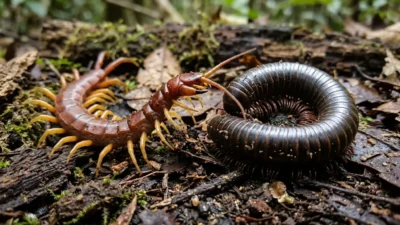
Have you ever seen a small, many-legged creature crawling under a rock, in your garden, or across a damp floor? You may have wondered whether it was a centipede or a millipede. These two creatures look similar at first, but they have important differences. Knowing how to identify them can help you understand their behavior and decide how to handle an unexpected encounter.
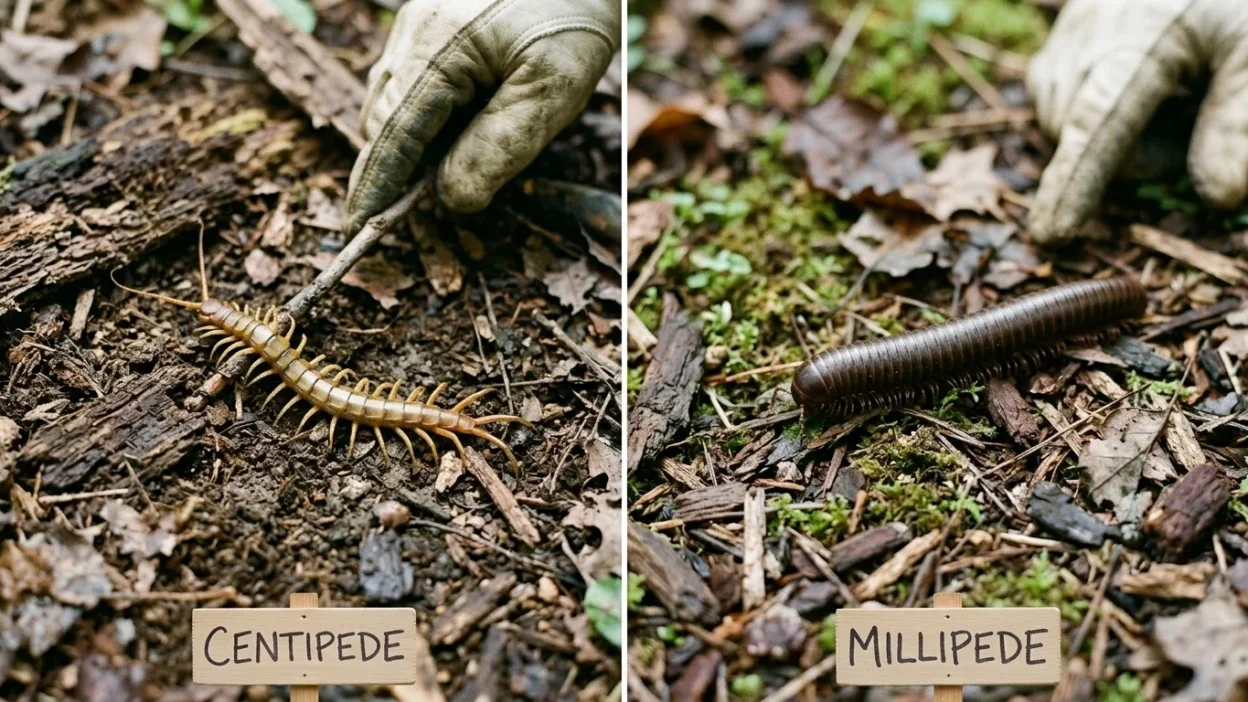
The main difference between a centipede and a millipede is their body shape, legs, speed, and diet. Centipedes usually have flatter bodies, move quickly, and hunt other small animals. Millipedes generally have rounded bodies, move slowly, and feed mainly on decaying plant material. Although both belong to the group of animals called myriapods, they are not the same. In this guide, you will learn how to tell them apart, where they live, what they eat, and whether they can harm people.
Quick Answer
A centipede usually has one pair of legs per body segment, a flatter body, and a fast, predatory lifestyle. A millipede usually has two pairs of legs on most body segments, a rounded body, and a slow, plant-decaying diet. Centipedes can bite, while millipedes usually defend themselves by curling up or releasing irritating chemicals.
Why Do People Confuse Centipedes and Millipedes?
People often confuse these creatures because both have long bodies, many legs, and similar habitats. They are commonly found in damp places, such as gardens, forests, under stones, and beneath fallen leaves.
Their names can also be misleading. The word centipede comes from Latin roots meaning “hundred feet,” while millipede means “thousand feet.” However, neither animal necessarily has exactly that number of legs.
The easiest way to tell them apart is to look at three things:
- Body shape: Centipedes are usually flatter, while millipedes are generally rounder.
- Movement: Centipedes move quickly, while millipedes usually crawl slowly.
- Legs: Centipedes have one pair of legs per body segment; millipedes have two pairs on most apparent body segments.
What Is a Centipede?
A centipede is a many-legged arthropod belonging to the class Chilopoda. It is a predator that hunts small insects, spiders, worms, and other tiny animals.
Main Characteristics of Centipedes
- Body: Usually long and flattened.
- Legs: One pair per body segment.
- Movement: Often fast and agile.
- Diet: Mostly insects and other small animals.
- Habitat: Damp soil, leaf litter, rocks, logs, and sometimes buildings.
- Defense: Uses modified front legs to deliver a venomous bite.
Centipedes have special appendages near their heads called forcipules. These are modified legs that help them inject venom into prey. Most species are not dangerous to healthy adults, but a bite can cause pain, redness, and swelling.
Centipedes are useful predators in gardens because they help control populations of small insects and other invertebrates.
What Is a Millipede?
A millipede is a many-legged arthropod belonging to the class Diplopoda. Unlike centipedes, millipedes mainly feed on decaying leaves, dead plant material, and other organic matter.
Main Characteristics of Millipedes
- Body: Usually rounded or cylindrical.
- Legs: Two pairs on most body segments.
- Movement: Generally slow and steady.
- Diet: Mainly decaying plant material.
- Habitat: Moist soil, forests, compost, and leaf litter.
- Defense: Often curls into a coil or releases defensive chemicals.
Millipedes help nature by breaking down dead leaves and other plant material. This process returns nutrients to the soil and supports healthy ecosystems.
Most millipedes do not bite people. However, some species release chemicals that may irritate the skin or eyes. It is best to avoid handling unfamiliar millipedes with bare hands.
Centipede vs Millipede: Comparison Table
| Feature | Centipede | Millipede |
| Scientific class | Chilopoda | Diplopoda |
| Body shape | Usually flat | Usually rounded |
| Legs per segment | One pair | Two pairs on most segments |
| Speed | Usually fast | Usually slow |
| Main diet | Small animals and insects | Decaying plant material |
| Behavior | Active hunter | Mostly feeds on organic matter |
| Defense | Venomous bite | Curling up or defensive chemicals |
| Antennae | One pair | One pair |
| Habitat | Damp, sheltered places | Moist soil and leaf litter |
| Role in nature | Controls small animal populations | Helps decompose dead plants |
| Risk to humans | Can deliver a painful bite | Usually harmless but may release irritating chemicals |
Important: The exact appearance, size, speed, and defense mechanisms vary among species. These are general differences, not rules that describe every individual.
When Should You Use Each Word?
Use centipede when you are talking about an animal from the class Chilopoda. Use millipede when you mean an animal from the class Diplopoda.
These words are not interchangeable, even though both animals have many legs.
For example:
- “I saw a centipede hunting a small insect.”
- “A millipede was crawling through the wet leaves.”
- “The centipede moved quickly when I lifted the rock.”
- “The millipede curled up when it was disturbed.”
When identifying an animal, look at its body shape, movement, and legs rather than relying only on its color or size.
12 Examples of Centipedes and Millipedes in Everyday Life
Here are practical examples to help you understand the difference.
- A fast creature under a rock: If it has a flattened body and moves quickly to catch insects, it may be a centipede.
- A slow creature in wet leaves: If it has a rounded body and crawls steadily, it may be a millipede.
- An animal chasing an insect: Centipedes commonly hunt insects and other small invertebrates.
- A creature eating dead leaves: Millipedes commonly feed on decaying plant material.
- A many-legged animal running away: Rapid movement may suggest a centipede, although speed alone is not conclusive.
- A creature curling into a coil: This is a common defensive response among millipedes.
- An animal with a painful bite: A centipede may bite using its venom-delivering front appendages.
- A creature releasing a strong-smelling substance: Some millipedes release defensive chemicals when threatened.
- An animal found in compost: It could be a millipede feeding on decomposing material, though other small animals may also live there.
- A creature beneath a damp log: Either animal may hide in this cool, moist environment.
- An animal helping control pests: A centipede can reduce the number of small insects and other invertebrates.
- An animal helping improve soil: A millipede can help break down dead leaves and recycle nutrients.
These examples describe common behaviors. To identify a real animal accurately, consider several characteristics together.
Common Mistakes When Comparing Centipedes and Millipedes
Mistake 1: Thinking Millipedes Have Exactly 1,000 Legs
Millipedes do not necessarily have 1,000 legs. Their leg count varies by species and stage of development.
Mistake 2: Thinking Centipedes Have Exactly 100 Legs
Centipedes can have different numbers of legs. Their defining feature is one pair of legs per body segment, not a fixed total of 100.
Mistake 3: Assuming All Many-Legged Creatures Are Dangerous
Centipedes can bite, and some bites are painful. Millipedes generally do not bite people, but their defensive chemicals can irritate the skin or eyes.
Mistake 4: Believing Millipedes Are Worms
Millipedes may look like worms, but they are arthropods. They have jointed legs and an external skeleton.
Mistake 5: Assuming Color Always Identifies the Animal
Both groups contain species with different colors and patterns. Body shape, leg arrangement, and behavior are more useful clues.
What Is an Easy Memory Trick?
Remember this simple rule:
Centipede = one pair of legs per segment and a hunter.
Millipede = two pairs on most body segments and a plant-material eater.
You can also remember that centipedes are often flatter and faster, while millipedes are generally rounder and slower.
This memory trick is useful for a quick comparison, but remember that individual species can differ.
American vs British English
There is no major spelling difference between American and British English for these words.
- American English: centipede, millipede
- British English: centipede, millipede
Both spellings are standard in the United States and the United Kingdom. The pronunciation may vary slightly by accent, but the meaning remains the same.
Similar Words You Should Know
Several terms are related to centipedes and millipedes.
- Myriapod: A group of arthropods that includes centipedes, millipedes, and their relatives.
- Arthropod: An animal with jointed legs and an external skeleton. Insects, spiders, centipedes, and millipedes are arthropods.
- Insect: An arthropod with six legs as an adult, usually divided into three main body regions.
- Spider: An arachnid with eight legs, not a centipede or millipede.
- Woodlouse: A small terrestrial crustacean often found in damp places. It is not a millipede.
- Earthworm: A segmented worm without jointed legs or an external skeleton.
- Decomposer: An organism that helps break down dead organic material. Millipedes contribute to decomposition by feeding on decaying plant matter.
Understanding these terms makes it easier to identify different small animals and understand their roles in nature.
Final Verdict: Centipede vs Millipede
The main difference between a centipede and a millipede is how they are built and how they live. Centipedes usually have flat bodies, one pair of legs per segment, and a predatory diet. Millipedes generally have rounded bodies, two pairs of legs on most body segments, and a diet based mainly on decaying plants.
If you see a fast-moving animal hunting small creatures, it may be a centipede. If you see a slow-moving animal feeding on dead leaves or curling up when disturbed, it may be a millipede.
Both animals play important roles in nature. Centipedes help control small invertebrates, while millipedes help recycle nutrients into the soil.
Frequently Asked Questions
1. Which is more dangerous, a centipede or a millipede?
Centipedes are generally more likely to hurt a person because they can deliver venomous bites. Most millipedes do not bite, but some release chemicals that can irritate skin or eyes. Avoid handling either animal unnecessarily.
2. Can a millipede bite you?
Millipedes generally do not bite people. Their main defenses are curling into a coil and, in many species, releasing chemicals that discourage predators.
3. Do centipedes have 100 legs?
Not always. The number of legs depends on the species. Centipedes have one pair of legs per body segment, but their total leg count varies.
4. Do millipedes really have 1,000 legs?
No, not necessarily. The word millipede means “thousand feet,” but most millipedes have fewer than 1,000 legs. Their actual number depends on the species.
5. What do centipedes and millipedes eat?
Centipedes are predators that usually eat insects, spiders, worms, and other small animals. Millipedes mainly eat dead leaves and other decaying plant material, although some species have different diets.
6. Why do centipedes and millipedes enter houses?
They may enter houses while seeking moisture, shelter, or food. Centipedes may hunt small insects indoors, while millipedes may wander inside from damp outdoor areas. Sealing gaps, reducing moisture, and removing leaf litter near foundations can help reduce encounters.
7. What should I do if I find a centipede or millipede indoors?
Avoid touching it with bare hands. If it is safe to do so, use a container and a piece of stiff paper to move it outside. Keep children and pets away, and wash your hands after contact. If a bite or chemical exposure causes severe symptoms, seek medical advice.
Remember This
- Centipedes: Usually flat, fast, and predatory, with one pair of legs per body segment.
- Millipedes: Usually rounded, slow, and plant-material eaters, with two pairs of legs on most body segments.
- Safety: Centipedes can bite, while millipedes may release irritating chemicals.
- Nature: Both help maintain healthy ecosystems in different ways.
Conclusion
Centipedes and millipedes may look alike, but they have different body structures, diets, and behaviors. Centipedes are usually fast hunters, while millipedes are slow feeders that help break down dead plant material. Learning these differences makes it easier to identify them in your garden or home.
The next time you spot a many-legged creature, check its body shape, legs, and movement before deciding which one it is. Remember that both animals are valuable parts of nature, and the safest approach is to observe them without handling them.

Claire Ella is the Administrator of BiblePeak, overseeing content quality, website operations, and community engagement. She is dedicated to presenting coded Bible insights with accuracy, clarity, and integrity, ensuring every visitor enjoys a trustworthy, meaningful, and enriching experience.