
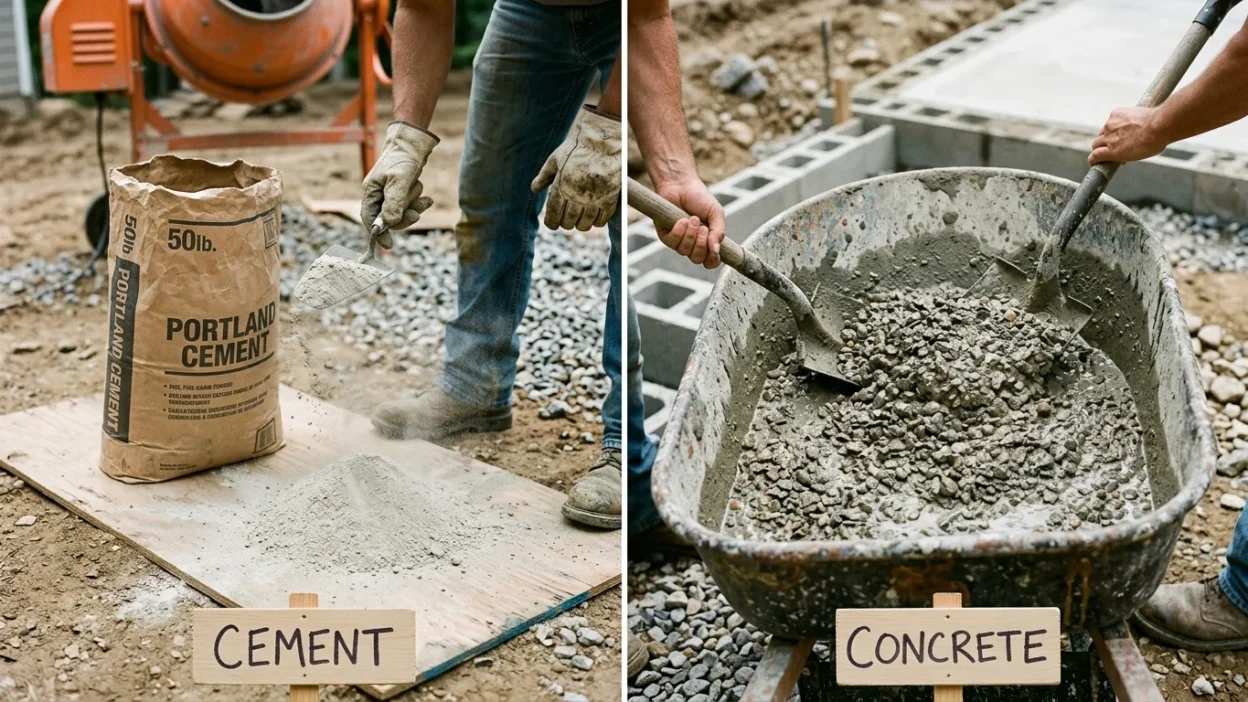
When people talk about building a house, laying a driveway, or making a sidewalk, they often use the words cement and concrete as if they mean the same thing. However, cement and concrete are different materials, and knowing the difference can help you understand construction projects more clearly.
Cement is a fine powder that acts as a binding ingredient. Concrete is a complete building material made by mixing cement with water, sand, and gravel or other aggregates. When water reacts with cement, the mixture hardens and helps hold the other materials together. Concrete is widely used for foundations, roads, floors, bridges, and buildings because it can provide strong, durable support when properly designed and cured.
Quick Answer: Cement vs Concrete
Cement is a binding powder, while concrete is a building material made from cement, water, sand, and gravel or other aggregates. Cement is one ingredient in concrete, not another name for the finished material. In simple terms, cement helps concrete harden, while concrete is what builders use for many construction projects.
Why Do People Confuse Cement and Concrete?
People confuse these terms because cement is an important ingredient in concrete. Both are used in construction, and both are associated with hard, gray surfaces.
For example, someone might say, “The workers poured cement for the driveway.” In everyday conversation, people understand what they mean. However, the more accurate expression is “The workers poured concrete for the driveway.”
The difference becomes easier to remember when you think about ingredients and finished products. Flour is an ingredient in bread, just as cement is an ingredient in concrete.
What Is Cement?
Cement is a fine powder that acts as a binding material. When mixed with water, it undergoes a chemical reaction called hydration. This reaction causes the cement paste to set and harden.
Portland cement is one of the most common types used in construction. It is manufactured from materials such as limestone and clay, which are processed at high temperatures and ground into a fine powder.
What Is Cement Used For?
Cement is used to make several construction materials, including:
- Concrete: Used for foundations, roads, slabs, and structural elements.
- Mortar: Usually made with cement, sand, and water, and used to join bricks or blocks.
- Grout: Used to fill gaps and spaces in various construction applications.
Cement is not usually poured by itself to create a large structural foundation. It is generally combined with other materials to make a suitable construction mixture.
What Is Concrete?
Concrete is a mixture of cement, water, fine aggregate such as sand, and coarse aggregate such as gravel or crushed stone. Other ingredients, called admixtures, may be added to improve certain properties.
When water and cement react, they form a hardened paste that binds the aggregates together. The result is a solid material that can support heavy loads when properly designed, placed, and cured.
What Is Concrete Used For?
Concrete is commonly used for:
- House foundations and building structures
- Driveways and sidewalks
- Roads, bridges, and tunnels
- Floors, patios, and parking areas
- Retaining walls and other structural elements
Concrete can also contain reinforcing steel, known as rebar, to help resist tensile forces.
Cement vs Concrete: Comparison Table
| Feature | Cement | Concrete |
| What is it? | A binding powder | A complete construction mixture |
| Main ingredients | Manufactured cement compounds | Cement, water, sand, and coarse aggregate |
| Appearance | Usually a fine gray powder | A wet mixture or hardened solid |
| Main purpose | Binds materials together | Forms building surfaces and structures |
| How it hardens | Reacts with water through hydration | Hardens as its cement paste reacts with water |
| Common uses | Making concrete, mortar, and grout | Foundations, roads, floors, and bridges |
| Can it be used alone? | Usually serves as an ingredient | Can be placed as a construction material |
| Example | A bag of Portland cement | A concrete driveway |
When Should You Use Cement or Concrete?
The right choice depends on the construction task.
Use Cement When You Need a Binding Ingredient
Cement is appropriate when preparing mixtures such as concrete or cement mortar. It helps bind sand, gravel, bricks, and other materials, depending on the mixture.
For example, a builder uses cement as one ingredient when preparing concrete for a house foundation.
Use Concrete When You Need a Strong Building Material
Concrete is generally the correct choice for larger structural and outdoor projects, including:
- Building a foundation
- Creating a driveway
- Pouring a patio
- Constructing a sidewalk
- Making concrete steps
The mixture must be designed for the job. Concrete strength depends on factors such as the proportions of its ingredients, the water-to-cement ratio, placement, and curing.
12 Examples of Cement vs Concrete in Everyday English
These examples show how to use both words correctly.
- Cement: The builder ordered ten bags of cement.
- Concrete: The workers poured concrete for the foundation.
- Cement: Cement is used to make many types of concrete.
- Concrete: Our new driveway is made of concrete.
- Cement: The cement must be stored in a dry place.
- Concrete: The concrete floor needs time to cure.
- Cement: The contractor selected Portland cement for the project.
- Concrete: The bridge uses reinforced concrete.
- Cement: Water reacts with cement during hydration.
- Concrete: The sidewalk was made from concrete.
- Cement: The cement was mixed with water and sand to prepare mortar.
- Concrete: The crew used a concrete mixer to prepare material for the building project.
Example Sentences in Conversation
Person A: What material are they pouring into the driveway?
Person B: Concrete.
Person A: What does cement do?
Person B: Cement binds the ingredients together as the concrete hardens.
Common Mistakes When Using Cement and Concrete
Mistake 1: Treating Both Words as Synonyms
Incorrect: “The cement driveway is being poured.”
More precise: “The concrete driveway is being poured.”
Although people often say “cement driveway” informally, “concrete driveway” is the technically correct term.
Mistake 2: Thinking Cement Is Stronger Than Concrete
Cement and concrete are not directly comparable in this way because they are different materials. Concrete’s strength depends on its mix design, curing, and other factors.
Mistake 3: Thinking Concrete Is Just Cement and Water
Concrete usually includes sand and coarse aggregate as well as cement and water. A mixture of cement and water alone is called cement paste.
Mistake 4: Assuming Concrete Dries Like Paint
Concrete does not gain strength simply by drying. It hardens through a chemical reaction called hydration. Proper curing helps maintain the moisture and temperature conditions needed for strength development.
What Is an Easy Memory Trick for Cement vs Concrete?
Remember this simple phrase:
Cement is an ingredient; concrete is the finished mixture.
Think of making a cake. Flour is one ingredient, but the cake is the finished product. In the same way, cement is one ingredient in concrete.
Another easy way to remember the difference is to picture a bag of cement beside a finished concrete sidewalk.
American vs British English: Cement and Concrete
The words cement and concrete have essentially the same meanings in American and British English.
| Term | American English | British English |
| Cement | Binding powder | Binding powder |
| Concrete | Cement-based construction material | Cement-based construction material |
| Cement mixer | Common term | Common term; concrete mixer is also used |
| Concrete pavement | Common expression | Concrete paving is also used |
The main difference is not the meaning of the words but how people use them in everyday conversation. In both varieties of English, concrete is the more accurate term for the hardened material used in a driveway or foundation.
What Words Are Similar to Cement and Concrete?
Several construction terms are related to cement and concrete, but they do not all mean the same thing.
- Mortar: A mixture commonly made from cement, sand, and water, used to join masonry units.
- Grout: A flowable material used to fill gaps, joints, or spaces.
- Cement paste: A mixture of cement and water.
- Cement slurry: A fluid mixture containing cement and water, sometimes with other ingredients.
- Aggregate: Sand, gravel, or crushed stone used in concrete.
- Reinforced concrete: Concrete containing steel reinforcement to improve its ability to resist tensile forces.
- Cementitious material: A material that contributes to binding through cement-like reactions.
Understanding these terms makes construction instructions and building discussions easier to follow.
Final Verdict: Cement vs Concrete
The key difference is simple: cement is a binding ingredient, while concrete is a mixture made using cement, water, sand, and aggregates.
If you are talking about a foundation, driveway, sidewalk, or concrete floor, use the word concrete. If you mean the fine powder that binds the ingredients together, use cement.
FAQs About Cement vs Concrete
1. Is cement the same as concrete?
No. Cement is a binding powder used as an ingredient in concrete. Concrete is made from cement, water, sand, and coarse aggregates.
2. Which is stronger, cement or concrete?
They are different materials and cannot be compared directly without defining the test. Concrete’s strength depends on its mixture, curing, and intended use.
3. Can you make concrete without cement?
Yes, some alternative binders can be used to produce concrete-like materials. However, ordinary Portland cement concrete relies on Portland cement as its main binder.
4. Is cement used to make concrete?
Yes. Cement reacts with water to form a hardened paste that binds the sand and coarse aggregates together.
5. Should I say cement driveway or concrete driveway?
Concrete driveway is the more technically accurate expression because the driveway is made from concrete, not cement alone.
6. Does concrete harden by drying?
No. Concrete gains strength mainly through hydration, a chemical reaction between cement and water. Proper curing supports this process.
7. Is mortar the same as concrete?
No. Mortar is commonly made from cement, sand, and water and is used to join bricks or blocks. Concrete usually includes coarse aggregate and is commonly used for structural elements and slabs.
8. How long does concrete take to harden?
Concrete can become firm enough for limited use within hours, depending on the mixture and conditions, but strength develops over time. A common reference point is 28 days for specified compressive strength, although actual performance varies.
Remember This
- Cement = binding ingredient.
- Concrete = cement + water + sand + coarse aggregate.
- Mortar = a mixture commonly used to join bricks and blocks.
- Use concrete when describing most poured driveways, sidewalks, and foundations.
Conclusion
Cement and concrete are closely related, but they are not the same. Cement is a fine powder that binds materials together, while concrete combines cement with water, sand, and coarse aggregates to create a strong building material.
The next time you see a worker pouring a driveway or building a foundation, remember that they are usually pouring concrete. Knowing this simple difference will help you use the words correctly in everyday conversations and understand basic construction terms.

Alexander Cody is a Bible researcher and Christian writer at BiblePeak, dedicated to exploring biblical codes, Scripture insights, and faith-based studies. He creates clear, engaging, and well-researched content that helps readers better understand the Bible and its timeless messages.